Developer guide
Data Prism is a privacy layer, not a data source: everything it protects
comes from code an integrator writes and a reviewer signs off, plugged in
through a small set of Java SPIs. This guide is that code's own
documentation — what each extension point is for, and the order to learn
them in. docs/extending.md stays the full reference for
every detail below; this page is the map, not the manual.
If your source is a flat or shallow JSON REST API, you may not need to write
any of this at all — see
docs/protect-your-own-api.md for the
YAML-only path first.
The extension points
DataSourceAdapter<T>— one external system. It names itself (sourceName()), states the model it returns (responseType()), and fetches one record (fetch(DataRequest request)), never seeing anything a caller supplied beyond an entity type and a subject id (data-prism-core/src/main/java/io/github/aindriub/dataprism/core/DataSourceAdapter.java). Tutorial 1, below, writes one from nothing. Full reference: ImplementDataSourceAdapter.IdentityResolver— how a subject's per-source keys relate to one canonical identity. Most integrations use the shippedPassThroughIdentityResolveras-is; write your own only when your sources disagree about identity (data-prism-core/src/main/java/io/github/aindriub/dataprism/core/IdentityResolver.java). Tutorial 2 covers writing one. Full reference: ImplementIdentityResolver.AuditSinkand the classification annotations (@LlmExposedModel,@SensitiveData,@NonSensitive,@InternalIdentifier,@SubjectIdentifier) are also extension points a reviewed integration touches — the first is where audit events go (data-prism-core/src/main/java/io/github/aindriub/dataprism/audit/AuditSink.java), the second is what makes a field safe to return through MCP at all. The classification annotations are used, not yet explained, in tutorial 1 below;AuditSinkdoes not appear there. A later part of this guide covers both on their own. Until then, see Classify the model with@LlmExposedModelin the full reference.
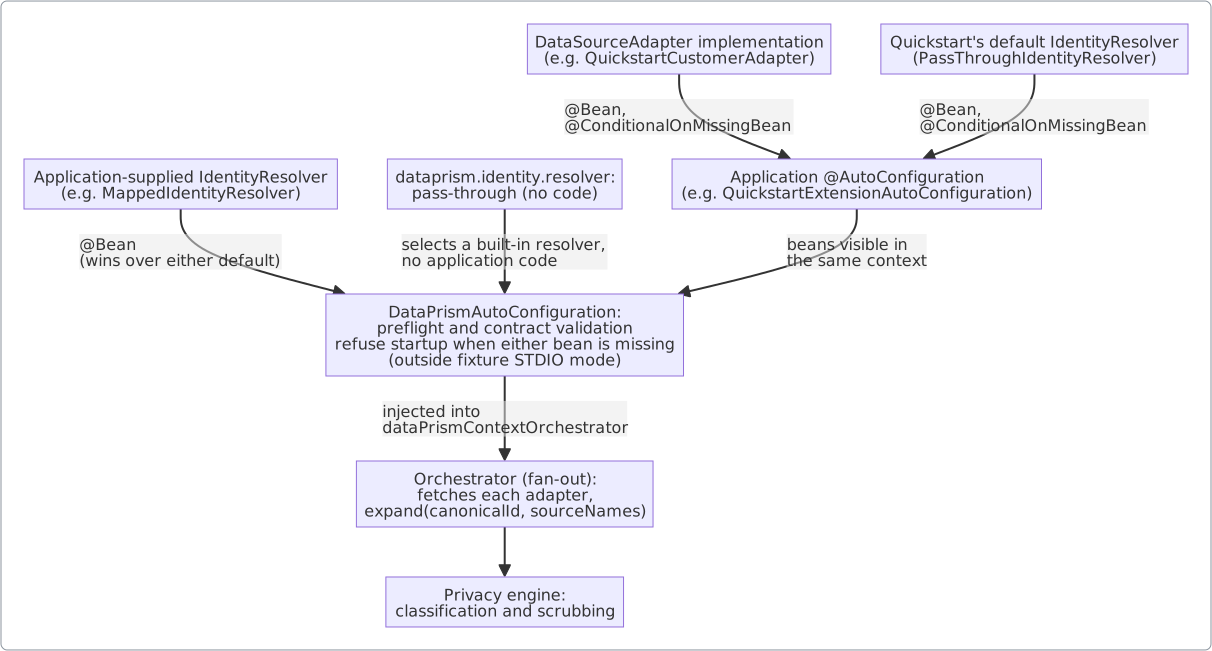
The diagram below shows the reviewed-adapter path where a DataSourceAdapter
and an IdentityResolver plug in: an application's own @AutoConfiguration
registers a DataSourceAdapter bean, but an IdentityResolver can instead
come from a dataprism.identity.resolver: pass-through setting with no code
at all. (A YAML-configured JSON source is a separate path this diagram does
not cover: it gets its DataSourceAdapter from
ConfiguredJsonSourcesInitializer with no application code either, per
docs/protect-your-own-api.md.) Either way,
DataPrismAutoConfiguration refuses to start when either kind of bean is
missing (outside fixture STDIO mode, where that check is skipped), and
everything a DataSourceAdapter returns still passes through the privacy
engine before anything downstream sees it.
Where to start
- Write a data-source adapter — from an empty module
to a pseudonymised MCP response, using
DataSourceAdapterand the classification annotations. - Write a custom identity resolver — how one
subject is recognised across sources, how
pass-throughdiffers, and how to register a resolver of your own.
Both walk through a real, compiled, tested module in this repository
(data-prism-quickstart-extension); every code block on those pages is
pulled directly from it, not hand-copied.