Configuration contract
This is the deployment contract for Data Prism. It applies to both supported surfaces:
- Standalone server (primary product). An operator runs the Streamable HTTP MCP server in front of existing APIs.
- Spring Boot starter (embedded option). An application supplies reviewed Java components and receives the same protected HTTP surface.
The two surfaces consume one dataprism.* vocabulary and construct one privacy
pipeline. They are not two implementations with subtly different security
rules. Runtime binding and validation of this contract is delivered by the
planned auto-configuration module; until then, the example application's
manual wiring is an implementation detail, not a production configuration API.
Supported modes
| Mode | Supported use | Required inbound transport | Source integration |
|---|---|---|---|
| Standalone server | Protect existing APIs | Authenticated Streamable HTTP | Reviewed adapters supplied by the server distribution; initially Java-first REST adapters only |
| Spring Boot starter | Embed Data Prism in a Spring application | Authenticated Streamable HTTP | Application-owned DataSourceAdapter and IdentityResolver beans, with annotated model types |
| Fixture development | Local examples and tests only | stdio, one fixed development principal | Fixture adapters only |
Stdio is never enabled for a protected API, never accepts production caller credentials, and never represents multiple principals. A profile, environment variable, Compose file, or agent configuration cannot turn it into a production transport. Protected APIs use authenticated Streamable HTTP behind an OAuth2 resource server.
A non-servlet Spring application (spring.main.web-application-type=none or
WebFlux) using the starter at the default or explicit mode: http also
refuses startup rather than running with no MCP transport registered at all:
the Spring auto-configuration's dataPrismMcpTransportPreflight bean refuses
with MCP_TRANSPORT_UNAVAILABLE before any DataPrism singleton is
constructed. Four codes now mean "this deployment has no usable MCP
transport", each at a different layer: STDIO_DEVELOPMENT_ONLY (stdio
requested without fixture development), STDIO_TRANSPORT_UNSUPPORTED (stdio
requested inside a Spring context), STANDALONE_HTTP_ONLY (the standalone
server only supports protected HTTP), and MCP_TRANSPORT_UNAVAILABLE (HTTP
requested or defaulted, but the application is not a servlet web
application). A consumer keying on "no usable MCP transport" must match all
four.
Configuration rules
- Configuration is server/operator controlled. MCP arguments cannot select a host, path, source, schema, field classification, caller, scope, purpose, or case identifier.
- A secret is supplied only by a reference to an approved secret provider or by the name of an environment variable. It is never a literal YAML value. A reference is sensitive operational metadata, but it is not secret material and may be logged only after review.
- A production deployment fails before accepting traffic when required configuration is absent, malformed, unsafe, or cannot be resolved. It must not start a server that silently protects no source.
- Names in this document use Spring's relaxed binding spelling. For example,
dataprism.security.jwt.jwk-set-urimay bind tojwkSetUriin Java.
dataprism.* vocabulary
The table is the complete V1 vocabulary. Required means required in every
protected HTTP deployment unless a row says otherwise. Future implementations
may add keys only with a contract update; unknown keys are configuration errors
for the relevant group.
| Group | Required/default | Secret-bearing | Invalid or absent value |
|---|---|---|---|
dataprism.transport |
mode is http for protected deployments; http.path defaults to /mcp; mode: stdio is refused unconditionally by the Spring auto-configuration, so it is not a reachable value for either the standalone server or the Spring Boot starter — the fixture-development stdio path is data-prism-integration-tests's hand-built entry point, which never goes through this property |
No | Refuse startup for an unknown mode, a non-rooted/invalid path, mode: stdio (STDIO_TRANSPORT_UNSUPPORTED), or mode: http/default on a non-servlet application, which has no MCP transport bean at all (MCP_TRANSPORT_UNAVAILABLE) |
dataprism.security.jwt |
issuer, audience, and exactly one trusted JWKS/issuer-discovery location are required for HTTP |
Location is not a secret; any client secret is out of scope and forbidden here | Refuse startup for a missing issuer/audience/location, invalid HTTPS URI (except explicitly local test fixtures), or an unreachable/mismatched issuer at validation time |
dataprism.security.caller-claims |
Required mappings for principal, roles, and the trusted investigation/case attribute; purpose remains server policy, not a caller-selected mapping | No | Refuse startup for blank, duplicate, or reserved mappings, or mappings that would derive scope/purpose/case from tool arguments |
dataprism.security-policy |
At least one permitted purpose and one role-to-known-capability mapping are required | No | Refuse startup for an empty purpose list, an unknown capability, blank role/purpose, or a role with no capabilities |
dataprism.privacy |
profile is required; locale defaults to the locale-neutral vocabulary; no dataprism.* property loads a custom profile file; the server and starter load the bundled privacy-profiles-default.yaml, whose profiles DEFAULT and STRICT both set unclassified: FAIL_REQUEST, refusing the whole response for a field nobody classified; a production scope lifetime is required; descriptor-file is optional and, when unset, no descriptor file is ever read and classification comes from annotations alone |
No | Refuse startup for an unknown profile, an application PrivacyPolicyResolver bean that would replace the framework's profile-backed resolver, unsupported locale, or non-positive scope lifetime. A configured descriptor-file also refuses startup — never falling back to the annotation-only resolver — if the path does not exist, does not name a readable file, has no models section, or declares undeclaredFields: NON_SENSITIVE for a type; each failure names the property, never a line of the file's contents |
dataprism.privacy.hmac-key |
key-id and one provider reference/environment-variable name are required; the selected key is pinned for each scope |
Yes, by reference | Refuse startup if a literal key is configured, the reference is blank/unresolvable, the key is too weak, or key-id cannot be resolved; never fall back to a generated key |
dataprism.audit |
sink is required in production, one of approved-sink, slf4j, hash-chained; writer-id is required for every sink, not only a hash-chained one; file-path is required only when sink: hash-chained |
Sink credentials are yes, by reference | Refuse startup for an unknown sink, missing required sink reference, a hash-chained sink's file path missing or unusable, or missing/invalid writer identity; do not downgrade to no or slf4j auditing |
dataprism.metrics |
Defaults to the framework's no-op implementation only for fixture development; production requires an approved sink/registry binding | Sink credentials are yes, by reference when applicable | Refuse startup in production for an unknown or absent required sink; metrics failures after startup remain fail-safe and cannot change a privacy decision |
dataprism.hazelcast |
topology is required for a protected deployment and is one of two honest choices, never a default: embedded shares the read budget across every member of the cluster, and is the one a multi-instance deployment must choose; single-node is a real, supported choice too, but the budget it produces is enforced once per process, so a configured budget of 100 becomes 100 times the number of running processes — identity-cache TTL follows the privacy scope regardless of topology; re-identification index defaults to false; persistence/MapStore defaults to disabled |
Cluster/TLS credentials are yes, by reference when configured | Refuse startup for a missing topology (MISSING_CLUSTER_TOPOLOGY), an unknown topology (UNSUPPORTED_HAZELCAST_TOPOLOGY), embedded with the optional Hazelcast dependency absent from the classpath (MISSING_SHARED_BUDGET, never a silent fall back to the per-process budget), persistence/MapStore enablement without an explicit reviewed configuration, invalid member/TLS settings, non-positive TTL, or an enabled index without its required controls |
dataprism.sources |
One named source entry per configured Java-first REST adapter; each entry declares a server-controlled HTTPS base URL and positive timeout | mTLS key, trust material, and service credentials are yes, by reference | Refuse startup for duplicate names, an unapproved/non-HTTPS URL (local fixture exception only), user-info/query/fragment in a base URL, invalid timeout, unresolved mTLS reference, or a configured source without its explicit adapter bean |
dataprism.sources.<name> is intentionally limited to transport parameters
owned by a reviewed adapter: base-url, timeout, and approved mTLS/service
credential references. It is not a generic request template. An adapter owns
the endpoint path, response type, source-name aliasing, and conversion to an
annotated LLM-exposed model.
Representative protected deployment
This illustrates names and shape only. The values named with *_REF are
references, not secrets, and the configuration binder must reject a literal
key, password, token, or private-key value.
dataprism:
  transport:
    mode: http
    http:
      path: /mcp
  security:
    jwt:
      issuer: https://issuer.example.internal
      audience: data-prism-mcp
      jwk-set-uri: https://issuer.example.internal/.well-known/jwks.json
    caller-claims:
      principal: sub
      roles: roles
      investigation: investigation_id
  security-policy:
    purposes: [investigation]
    roles:
      investigator: [GET_ENTITY_CONTEXT]
  privacy:
    profile: DEFAULT
    locale: neutral
    scope-lifetime: 8h
    hmac-key:
      key-id: v1
      environment-variable: DATAPRISM_HMAC_KEY_REF
  audit:
    sink: approved-sink
    writer-id: ${HOSTNAME}
  metrics:
    sink: micrometer
  hazelcast:
    topology: embedded
    reidentification-enabled: false
  sources:
    customer:
      base-url: https://customer-api.internal
      timeout: 2s
      mtls:
        key-reference: CUSTOMER_MTLS_KEY_REF
        trust-reference: CUSTOMER_MTLS_TRUST_REF
The Spring Boot starter additionally requires application beans for every
configured source and for IdentityResolver. The standalone server uses the
same validation, but can only expose adapters packaged and reviewed with that
distribution. In either mode, a missing adapter or resolver is a startup
refusal.
dataprism.identity.resolver
Selects a built-in IdentityResolver bean for an operator with no Java to
write. pass-through is the one accepted value — it selects
PassThroughIdentityResolver, correct only when every configured source
genuinely shares the same identifier already; an application-supplied
IdentityResolver bean always wins over it, never producing two. Any other
non-blank value refuses startup with UNSUPPORTED_IDENTITY_RESOLVER. Leaving
the property unset (or blank) selects nothing: with no IdentityResolver
bean present either way — neither the built-in one nor an application-
supplied one — startup refuses with MISSING_IDENTITY_RESOLVER.
dataprism.audit
This section describes the protected-deployment path: mode: http, in both
the standalone server and the Spring Boot starter. It is not describing
mode: stdio. Requested without fixture-development=true, that is itself
refused before any of this section's checks run, with STDIO_DEVELOPMENT_ONLY
(see "Supported modes" above). Requested with fixture-development=true
inside a Spring application, the Spring auto-configuration always refuses
startup, normally with STDIO_TRANSPORT_UNSUPPORTED — that combination
never reaches a usable, protected deployment either.
sink is required; a missing value refuses startup with MISSING_AUDIT_SINK.
It accepts exactly three values:
approved-sink— the deployment must supply its ownAuditSinkbean; absent one, startup refuses withAUDIT_SINK_BEAN_REQUIRED.slf4j— the built-inSlf4jAuditSink, safe to ship to ordinary log infrastructure because nothing read from a source payload reaches it.hash-chained— the built-in hash-chainedFileAuditSink. Requiresdataprism.audit.file-path; a missing path refuses startup withMISSING_AUDIT_FILE_PATH, and a path that cannot be opened (a parent directory that does not exist, or one this process cannot write to) refuses withAUDIT_SINK_FILE_UNUSABLE— startup never falls back to no orslf4jauditing either way. Seedocs/audit.mdfor the chain itself,instanceId, and the offline verifier.
An unrecognised sink value refuses startup with UNKNOWN_AUDIT_SINK.
writer-id is required for every sink, not only hash-chained — a
missing one refuses startup with MISSING_AUDIT_WRITER regardless of which
sink is configured. It need not be unique per boot: each boot mints its own
instanceId as <writer-id>/<uuid> (see docs/audit.md), so the same
writer-id across restarts is expected, not a collision. It must not itself
contain / — AuditRecorder splits instanceId on that character, so a
writer-id containing one would make the split ambiguous — and one that does
refuses startup with INVALID_AUDIT_WRITER. ${HOSTNAME} in the example
above is one convenient, non-unique-per-boot choice; it is not a requirement.
A dataprism.audit.credential-reference, when configured, must not be
blank; a blank one refuses startup with INVALID_AUDIT_REFERENCE.
The diagram below shows the three outcomes a field's classification can lead to.
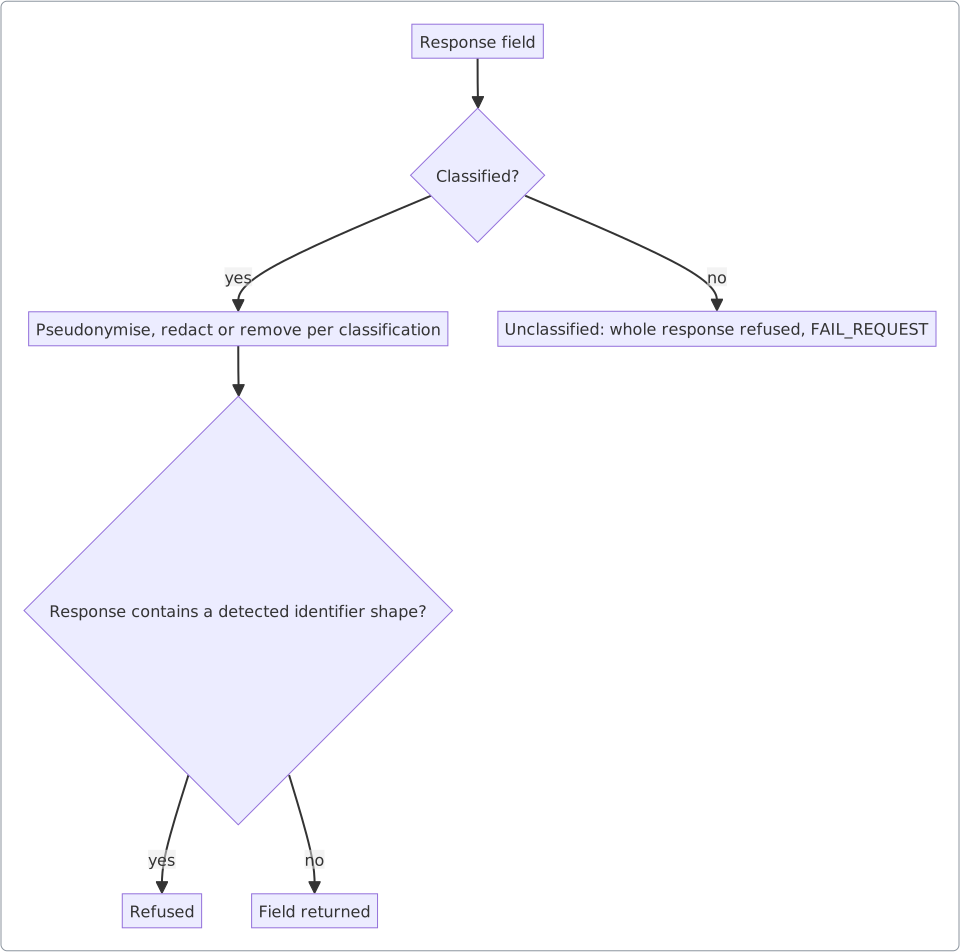 Select the diagram to open it full size.
Java-first now; generic JSON as a separately reviewed extension
V1 is Java-first. A source adapter is application/distribution code with an annotated response model. Configuration selects and parameterises that reviewed adapter; it does not classify a DTO from its name or infer safety from an API endpoint.
A configuration-driven JSON REST mode exists, but it is never a hidden
interpretation of dataprism.sources, and it is never part of the base
standalone server distribution. It ships in data-prism-connectors-rest, a
separate artefact an operator opts into the same way as any other reviewed
adapter: -Dloader.path=<data-prism-connectors-rest jar>. Absent that jar and
its one property, a deployment is unaffected and this section does not apply.
dataprism.json-sources.config-location
The one property this mode reads: a Spring resource location (classpath: or
file:) naming a YAML file with its own json-sources: root key, structurally
unrelated to dataprism.sources and never merged with it. Each named entry
under json-sources: states, and only states:
base-url,path(a fixed template with exactly one{subject}segment) andtimeout— server-owned transport, identical in kind to a Java-first source's, and this mode never defaults the timeout the way the Java-first loader does; it must be stated explicitly.model-version— an explicit, non-blank tag an operator commits to, reviewed alongside the catalogue below. It is a deployment-time contract, not a runtime check against the response body: a REST API rarely states its own schema version on every payload.subject-json-path— a bare property name (^[A-Za-z_][A-Za-z0-9_]*$; no dots, no scheme, no query, no second segment) naming the response field that carries this source's own correlation identifier. It must name an entry infields:markedidentifier: true, and nothing else about the grammar lets it reach anywhere outside the object the response already is.fields:— the allowlisted field classification catalogue, keyed by exact JSON property name. Every field this source may ever emit, including its subject field, must be named here with exactly one ofidentifier: true,nonSensitive: <reason>,classifications(with optionalnamespaceandaction), ornested: <name>. A property present in a response but absent from this map is refused before it reaches the scrubbing engine, the same UNKNOWN_FIELD refusal a Java-first model's own undeclared property gets.nested-catalogues:— a top-level map, keyed by catalogue name, of the named catalogues a root field'snested: <name>refers to. Nesting is exactly one level: a nested catalogue's own entries may benonSensitiveor classified only — statingidentifier:or a furthernested:inside one is refused at load time, naming the offending catalogue and field, since a nested catalogue carries no identifier of its own and this mode never descends a second level.
A response whose shape no longer matches a source's declared nesting is a
request-time privacy refusal, not a startup refusal — the catalogue was valid
at load time; the wire shape drifted from what it declared. data-prism-connectors-rest
raises NESTED_LEAF_NOT_SCALAR when a nested catalogue's own leaf field (one
with no nested: of its own) turns up as a structure in the response, and
NESTED_FIELD_NOT_STRUCTURED when a root field declared nested: turns up as
a scalar instead of the structure the catalogue expects. See
docs/protect-your-own-api.md's "A nested
response" section, which works NESTED_LEAF_NOT_SCALAR through a direct scrub
call (NestedCatalogueWalkthrough.java) rather than a running adapter, and
names NESTED_FIELD_NOT_STRUCTURED without a worked example of it.
An optional top-level tls: block, identical in shape to the one RestSource
already supports, requires every source in the file to use https.
Startup fails closed and names the offending source for: a missing or
malformed required key, an unknown top-level key, a subject-json-path
outside the bounded grammar or not matching a declared identifier field, a
field stating more than one (or none) of its four allowed shapes, an unknown
classification, namespace or action value, a nested: field naming an
undeclared catalogue, a declared catalogue referenced by no field, and
identifier: or nested: stated inside a nested catalogue's own entries. A
response that is not a JSON object, or that is missing at request time, is a
source failure or NO_DATA respectively, not a configuration error, and
neither is the nesting-shape mismatch described above.
A configured JSON source's transport is stated exactly once, in
json-sources:; it does not also need a dataprism.sources entry, and
DataPrismContractValidator does not require one — the base distribution's
contract validator recognises the DataSourceAdapter bean this mode
registers as reviewed without it appearing under dataprism.sources at all.
Naming it there too is allowed but never required; if you do, its base-url
must agree with the json-sources: value, and startup refuses, naming
both, if they disagree — the json-sources: value is always the
authoritative one actually dialled, so a dataprism.sources entry that
silently won an unused, disagreeing check would be exactly the hazard this
refusal closes.
The Compose quickstart's evaluation issuer
data-prism-quickstart-issuer (see docs/quickstart.md) is a fixture-only
evaluation JWT issuer, published as
ghcr.io/aindriub/data-prism-quickstart-issuer. It mints tokens for one
synthetic issuer/audience pair only, and is never a general-purpose identity
provider. Pointing a deployment's dataprism.security.jwt.jwk-set-uri at
it — its public signing key is served at /jwks, not
/.well-known/jwks.json — is only ever useful for local evaluation: doing so
still does not permit an unauthenticated call, since every request must carry
a token this issuer minted, signature-verified against that JWKS location
like any other. It does not, and cannot, substitute for
dataprism.transport.fixture-development=true, which the standalone server
refuses unconditionally regardless of which issuer a deployment trusts —
authenticating against this evaluation issuer is a real, if fixture-scoped,
authenticated HTTP deployment, never the stdio fixture-development path.
Ownership boundary
| Concern | Configuration may provide | Application/distribution code must provide |
|---|---|---|
| Inbound security | Issuer, audience, trusted claim names, role-to-capability policy | JWT-to-AuthenticatedCaller integration and HTTP resource-server wiring |
| Privacy pipeline | Selected profile, neutral locale, scope lifetime, key reference | Reviewed profile implementation, key-provider integration, and the single scrubbed mapper |
| Sources | Named adapter selection, base URL, timeout, mTLS/credential references | DataSourceAdapter, annotated model types, endpoint paths and response conversion. IdentityResolver too, unless dataprism.identity.resolver: pass-through selects the built-in PassThroughIdentityResolver instead |
| Operations | Audit/metric sink selection and references; embedded Hazelcast settings | Approved sink/registry/provider implementations and lifecycle wiring |
Neither configuration nor application code may make a concrete connector a
dependency of mcp or orchestration. Those modules see only the core SPI;
the configuration core is the wiring leaf that supplies implementations.