Architecture
The shape of the system: what the pieces are, what talks to what, and where the
boundaries are. explorer and architect read this before inferring structure
from the filesystem, so keeping it honest saves every session a search.
Modules marked planned in the table below do not exist on disk yet; they are
the target shape agreed in design-review.md. Everything else is built and
tested. Move a row out of planned when its module lands, and keep this file
honest — an architecture document that describes something other than the code
costs more than having none.
What the system does
An MCP client asks for context about an entity. Data Prism authenticates the caller, resolves a privacy scope from the authenticated session, fans out to the enterprise APIs that hold that entity, normalises what comes back, correlates it, replaces sensitive values with deterministic pseudonyms, checks the result for leaks, audits the whole thing, and only then answers.
Two things stay separate throughout, and confusing them is the most likely way to get this wrong:
- Identity is made consistent. The same subject gets the same pseudonym in every source, within one scope.
- Data is not. If three systems disagree about a name, the answer says so. The platform never makes the data look cleaner than it is.
Components
Modules, in dependency order. Arrows point at what a module is allowed to depend on; anything not listed is forbidden and is enforced by ArchUnit rather than by review.
| Module | Depends on | Owns |
|---|---|---|
annotations |
— | @InternalIdentifier, @SubjectIdentifier, @SensitiveData, @NonSensitive, @SensitiveObject, @LlmExposedModel, the classification/action/namespace enums |
processor |
annotations |
LlmExposedModelProcessor, the annotation processor that fails the build on a field of an @LlmExposedModel carrying neither @SensitiveData nor @NonSensitive(reason=...) (§B2) |
core |
annotations |
Privacy model, FieldMetadataResolver, PrivacyPolicyResolver, canonical envelope, provenance, InvestigationContext, SourceTree, every SPI interface the other modules implement, and the audit contract (AuditEvent, AuditSink, per-writer hash chain) |
pseudonymisation |
core |
HMAC generator, per-namespace synthetic generators, PseudonymRenderer, key and algorithm versioning |
hazelcast |
core |
Embedded member, identity cache, re-identification index, shared read budget, scope purge, FailSafeMetrics |
validation |
core |
SensitiveDataScanner, LlmResponseValidator, scope-aware pseudonym allowlist |
security |
core |
AuthenticatedCaller, AuthorizationService, PurposeValidator, ScopeResolver, PrivacySession, SecurityPolicy, ReservedArguments, ToolInvocation |
orchestration |
core + the above |
ContextOrchestrator, parallel fan-out, circuit breaker, request and cost limits, correlation and consistency findings |
mcp |
orchestration, security |
Tool definitions, schemas, transport, DataPrismObjectMapper |
connectors-rest |
core |
RestDataSource, source configuration, resilience |
connectors-search (planned) |
core |
Elasticsearch adapter with index and field allowlists |
reidentification (planned) |
hazelcast, security |
The controlled reverse-lookup surface. Separate application, separate port. The index it reads already exists in hazelcast, off by default |
spring-boot-autoconfigure |
the privacy/runtime modules | Shared dataprism.* binding, validation, privacy-pipeline wiring, MCP lifecycle and servlet registration |
spring-boot-starter |
spring-boot-autoconfigure |
Dependency-only embedded integration entry point |
server |
spring-boot-autoconfigure |
Primary executable Streamable HTTP MCP server, JWT boundary, health endpoint, production integrations and privacy metrics |
integration-tests |
everything, and declares security directly |
The reactor's cross-module integration test suite: 11 test classes exercising three stub sources with divergent representations end to end, including PiiLogScanTest, the sole enforcement of boundary 7 below |
Two directions matter and are easy to get backwards:
mcpandorchestrationmust not depend onconnectors-*. They seeDataSourceAdapterfromcore; the shared auto-configuration core supplies implementations at runtime. The pack's §9 dependency chain contradicts its own §72 ArchUnit rule on this point — the rule is right.- No core, privacy, MCP or orchestration module depends on a wiring or
distribution module.
spring-boot-autoconfigureis the wiring leaf; the starter and server intentionally consume that shared core rather than implementing separate privacy paths. Nothing else may depend on the starter or server except their launchers/examples.
Repository topology
One repository, one Maven reactor. There are no sibling project repositories.
.claude/ is untracked on purpose: it is a plain directory (verified with
fsutil reparsepoint query .claude — it is not a reparse point), populated by
installing an agent kit whose single clone lives outside every project it
serves and is refreshed with git -C <kit> pull. ~/.claude/agents and
~/.claude/commands, not anything under this repository's .claude/, are the
symlinks into that kit, shared by every project. Tracking any of it here would
fork the harness from its upstream, and committing its settings.json would
hand every contributor a tool-permission allowlist they never reviewed.
CONTRIBUTING.md says how to install it.
.worktrees/ is untracked and holds one checkout per running task.
docs/pack.md is the original specification, copied in verbatim so agents do not
have to reach outside the repository for it. It is a historical document and is
not edited. docs/design-review.md amends it and wins wherever the two disagree.
How they talk
Inbound. Protected APIs use Streamable HTTP behind an OAuth2 resource
server. Stdio is fixture-only, single-principal development transport; it is
never a route to a protected API. The rule is a closed tool set, not an open
one: get_entity_context and compare_entity_sources exist today;
search_entity_data and describe_entity_model are designed (§B5) but not
built, and none of the four is a ceiling that gets relaxed by adding a tool
nobody reviewed. Backend endpoints are never exposed one-to-one — that would
hand privacy and correlation decisions to the caller.
Outbound. RestClient over mTLS to enterprise APIs, one adapter per source,
endpoints configured server-side only. Elasticsearch through an adapter that
translates a controlled query grammar; raw DSL never reaches it.
Deployment. The standalone server is the primary product for protecting
existing APIs; the Spring Boot starter is the embedded integration option. Both
consume the single validated dataprism.* contract in
configuration.md. Configuration parameterises reviewed adapters but does not
infer classifications, create arbitrary JSON mappings, or let MCP callers
choose a backend. Java-first adapters and annotated models are the general
case, supported now. A configuration-driven JSON REST mode also ships today —
the separately published connectors-rest artefact, opted into via
-Dloader.path, no Java required — and its allowlisted fields: catalogue
covers one level of named nested sub-catalogues: a root field can declare
nested: <name> and point at a nested-catalogues: entry that is itself a
flat catalogue of scalar/classified leaves, using the root's nonSensitive
and classified leaf shapes — a nested catalogue carries no identifier of its
own and inherits its subject from the enclosing record. It goes no deeper
than that: a nested catalogue's own fields cannot themselves declare
nested: or identifier: true, so recursion is
refused at load time rather than left to depend on whatever the wire happens
to send. There is still no dotted path, no JSONPath and no expression
anywhere in this grammar — subject-json-path and every fields: or
nested-catalogues: key remain a single bare, exact-match property name — so
this mode still cannot reach a second path segment, an array index
expression, or anything outside the one object (or one level of nested
object) the response already is. See configuration.md and
docs/extending.md.
Sideways. An embedded Hazelcast member holding the identity cache, the shared read budget and — only where a deployment enables it — the re-identification index. Never raw source records, never business caching. The identity cache is an optimisation and losing it changes no answer; the read budget and the re-identification index are not, and are treated differently for that reason.
Concurrency. Virtual threads for the blocking fan-out, with per-source timeouts, circuit breakers, bulkheads and a bounded pool. An LLM in a retry loop is the realistic overload, not an attacker.
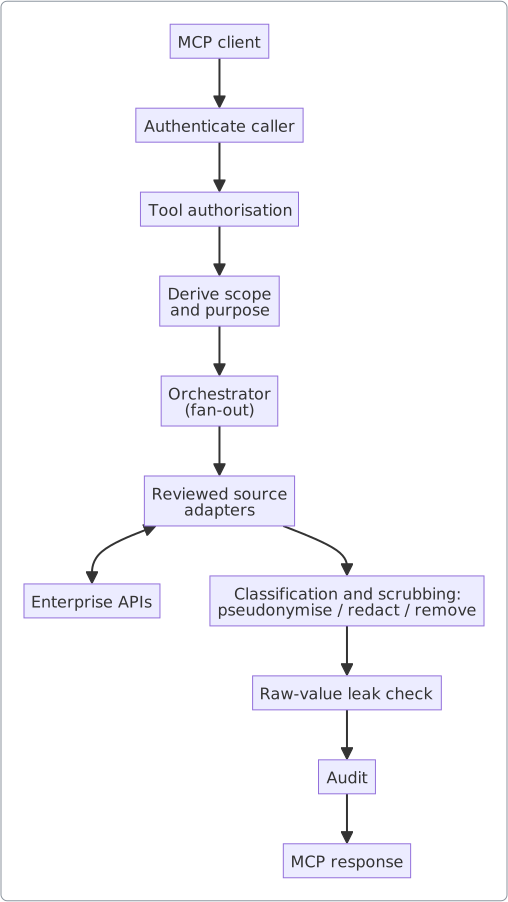
The diagram below traces one request end to end through these components.
Boundaries that must not be crossed
Violating any of these is a defect regardless of how the code reads or whether tests pass. Each is marked with what actually enforces it — the audited state as of 2026-09-09. Where the mark is prose only, nothing fails the build if the boundary is crossed; catching a violation depends on review.
- No source data reaches
mcpwithout passing the privacy engine. The engine is installed as a Jackson module on theObjectMapperthe MCP layer uses, so bypassing it means constructing a different mapper — which is the thing to look for in review. Enforced —ArchitectureTest .onlyDesignatedClassesCreateMappersforbids any class other thanDataPrismObjectMapperandSourceTreefrom constructing anObjectMapper. - The privacy engine operates on a data tree, not on the Java object graph.
Records are immutable and their constructors validate; reflective field
mutation is not an option and
Unsafeis not acceptable in a security component. Enforced —ArchitectureTest .privacyModulesDoNotMutateObjectGraphsReflectivelyforbidsUnsafe, reflective field mutation (Field#set*andsetAccessible), and field access throughVarHandleorMethodHandlesin the privacy modules. - A response that fails validation is not returned. There is no
log-and-continue path. Enforced —
ValidationBoundaryTest
   .validationFailureIsNotReturned
injects a validator refusal and asserts aPrivacyRefusedExceptionplus a DENY audit event rather than a response. - The caller never supplies its own scope, principal, purpose or case id.
All four derive from the authenticated session. A tool argument claiming any
of them is ignored and the attempt is audited. Enforced —
security'sReservedArgumentsstrips the named keys before a tool call is built, andEndToEndTestasserts content-equal behaviour between a plain call and one carrying the four rejected argument names, plus a single audited refusal. - Re-identification is never an MCP tool. Separate application, separate port, separate authorisation scope, mandatory purpose, mandatory audit. Prose only — the module does not exist yet (S10, deferred).
- Hazelcast never holds raw sensitive values — pseudonyms and subject ids
only. The identity cache never decides a value: every path through it returns
what the generator would have returned, including the path where the cluster
is gone. Enforced —
HazelcastStoredValueBoundaryTestdrives identity caching with re-identification and a read budget, inventories every live map, recomputes allowed state from decomposed keys, and rejects both unknown maps and the distinctive raw-value fixture in every key and value. - No sensitive value in a log line, metric label, trace attribute, exception
message or audit record. Search parameters are fingerprinted with an HMAC
under the scope key, not hashed. Partially enforced — the log half is
covered by
PiiLogScanTest, which scans captured log output for stub fixture identifying values, and the durable audit file half byAuditFilePiiScanTest(task 65), which scansFileAuditSink's own output the same way. Metric labels and trace attributes are still not scanned by any test. - The core carries no business domain. No
Customer,Taxpayer,EmployeeorAccounttype outside theio.github.aindriub.dataprism.examplepackage (hosted indata-prism-integration-tests; task 49 renamed the module but deliberately left this package name unchanged). Partially enforced —ArchitectureTest.coreDoesNotDependOnOuterLayerschecks the dependency direction (core cannot depend onmcp,orchestration, theexamplepackage orpseudonymisation), but nothing scanscorefor a business-domain type directly; a domain type added tocorethat no outer module happened to import would pass this rule.
ArchitectureTest lives in data-prism-architecture, not example —
task 23 moved these rules into their own scanning module, built specifically
to see the whole graph: its own javadoc records that CLASSES is imported
from every other module's compiled target/classes directly, including
data-prism-connectors-rest, data-prism-hazelcast,
data-prism-spring-boot-autoconfigure and data-prism-server, none of which
were reachable from the module these rules used to live in.
ArchitectureCoverageTest, alongside it, checks that this module list stays
complete. ArchitectureTest also enforces two rules not tied to a numbered
boundary above: securityDoesNotDependOnOuterLayers (security must work
the same from any transport, so it cannot depend on mcp, orchestration, a
connector or the example package) and onlyTheExampleDependsOnSpringSecurity
(Spring Security is the example application's own choice for turning a
verified JWT into an AuthenticatedCaller; data-prism-security itself must
stay framework-agnostic).
Decisions worth knowing
One line each, with the date and the alternative rejected. Longer reasoning for
all of these is in design-review.md under the section named.
- 2026-09-08 — Pseudonymisation is keyed on an explicit subject, not the
record's own identifier (§A1). Rejected: one
@InternalIdentifierper record, which merges two people named in one record into a single pseudonym. - 2026-09-08 — Pseudonyms carry a deterministic discriminator (§A2). Rejected: bare generated names, which collide by the birthday bound at roughly 6,000 subjects in a scope.
- 2026-09-08 — Correlation requires a resolvable key, behind an
IdentityResolverSPI (§A3). Rejected: probabilistic entity matching, which is a different product and would change the orchestrator's shape if bolted on. - 2026-09-08 — Scrubbing operates on a Jackson tree (§A4). Rejected: reflective object-graph scrubbing, which cannot write to records.
- 2026-09-08 — The output validator allowlists this scope's own pseudonyms (§A5). Rejected: naive pattern detection, which rejects every synthesised email and deadlocks the fail-closed path.
- 2026-09-08 — The audit hash chain is per writer, not global (§A6). Rejected: a single chain, which stateless horizontally-scaled instances fork into something indistinguishable from tampering.
- 2026-09-08 — Fail-closed requires
@NonSensitive(reason=...)and an annotation processor (§B2). Rejected: runtime-only fail-closed, which developers defeat by marking everythingPASS_THROUGH. - 2026-09-09 — Hazelcast runs embedded, reversing the earlier decision (§C4). The original objection was that members in an autoscaled deployment rebalance partitions on every scale event, which sounded ruinous for the map that decides what a subject is called. It is not, and the reason is a property this codebase now actually has: a synthetic value is a pure function of scope, subject, namespace and key, so a lost partition costs a recomputed HMAC and never a different answer. Rebalancing produces cache misses, not renamed people. Embedded removes a cluster to operate and a hop from every lookup. Accepted consequence: the re-identification index is a store rather than a cache — nothing can recompute a subject id from a pseudonym — so its durability is the cluster's durability, and an embedded cluster scaled to zero loses it. That index is therefore off unless a deployment enables it deliberately.
- 2026-09-09 — Metrics are guarded at construction, not at each call site
(
FailSafeMetrics). A wrapper applied once when the metrics implementation is built, so every emit site added later is guarded by construction rather than by a reviewer remembering to wrap it. Rejected: guarding individual emit calls, which the S8 wave 2 Hazelcast metrics work tried twice and missed a site each time — once leaving a broken fail-open guarantee reachable, once leaving a known-bad cached value in place because a throwing metric aborted the corrective write that should have followed it. The standing guarantee this buys: a conflicting meter registration, or any other metrics failure, can never fail a lookup. - 2026-09-09 — The read budget fails closed; the identity cache fails open. They look alike and are opposites. An unreachable identity cache costs computation and changes no answer, so it degrades. An unreachable budget means nobody is counting, and continuing would silently remove the only limit on how much a caller can extract about one subject.
- 2026-09-09 — Data Prism is an OAuth2 resource server, not a token issuer and
not a pass-through. It validates caller JWTs against a configured JWKS; it
never forwards the caller's token upstream, calling source systems under its
own service identity via mTLS instead. Rejected: pass-through, because the
caller is the untrusted party and forwarding its token would recreate the
LLM → Enterprise APIspath thatpack.md§87 asks network policy to make impossible. It would also collapse two different authorisation questions — "may this service fetch this record" and "may this caller see a pseudonymised view of it" — into the first. This makes Data Prism a confused deputy by construction, which is whyAuthorizationServiceis a separate contract from token verification: verification answers who the caller is, authorization answers what the caller may see, and neither is allowed to stand in for the other. RFC 8693 token exchange is a deliberate non-goal for this slice. - 2026-09-08 — Coordinates are
io.github.aindriub/data-prism-*, package rootio.github.aindriub.dataprism. Rejected: a group id under a project domain, which reads better but requires owning one — every close spelling ofdataprismis registered, anddata-prism.iois free but cannot be a Java package because hyphens are illegal in package names.io.github.<user>is verifiable on Maven Central through the GitHub account alone. The cost is that moving to an organisation later is a breaking coordinate change. - 2026-09-08 — The MCP layer uses the official MCP Java SDK directly, with
Spring wiring written here; stdio in development, streamable HTTP in
production. Rejected: the Spring AI MCP server starter, which supplies the
transport for free but couples the
mcpmodule to Spring AI's release train, and whose auto-registration of@Toolbeans is the expose-everything pattern the specification forbids. Verify the SDK coordinates and version at build time; this ecosystem moves faster than any document about it. - 2026-09-08 — No vendor client in core, for either secrets or audit. The
HMAC key arrives at startup through a
SecretKeyProviderSPI and lives in application memory;AuditSinkships a file/SLF4J implementation only. Rejected: bundling Vault, a cloud secrets client or Kafka, which would make every consumer of a generic library inherit a dependency and a deployment assumption they did not choose. Accepted consequence: a memory disclosure exposes the key for every scope, where a KMS-derived per-scope subkey would have limited it to live scopes. Reference implementations, if any, go in optional modules. - 2026-09-08 — Re-identification: the reverse map is built in S7, the operator surface is deferred past V1. Rejected: deferring both, because a reverse map added later cannot resolve any pseudonym issued before it existed, so every scope created in the interim would be permanently opaque. The map is cheap; the surface is what needs the security review, and that can wait.
- 2026-09-13 — One configuration core serves the standalone server and Spring
Boot starter. The server is the primary product and the starter an embedded
option; both bind and validate the same
dataprism.*vocabulary. Rejected: duplicate server/starter wiring, which would let safety rules diverge, and a configuration-only arbitrary-JSON adapter, which would make classifications and endpoint/schema choices implicit. See ADR 0001 andconfiguration.md. - 2026-09-08 — Build the walking skeleton first, then thicken it
(
development-plan.md). Rejected: the pack's layer-by-layer Phase 1–9 order, which defers proving the privacy boundary end-to-end until the last phase. - 2026-09-23 — The audit trail's threat model is a user, an operator, AND
any LLMs: it must be able to trace a sensitive-data exposure back to
whichever of the three caused it (§A6,
pack.md§54). An architect spike found thatpack.md§54,design-review.md§A6 and the S9 owner decisions all describe the per-writer hash chain mechanism without ever stating whose misbehaviour it catches; this closes that gap. Consequence, not a mechanism change today: the operator is now explicitly in scope, and the unkeyed SHA-256 chain (AuditEventHash) does not resist one — anyone with write access to the audit file can delete or alter a record and recompute every hash after it into a chain that verifies perfectly, as a tester demonstrated by injecting a fabricated writer with a self-computedeventHash. Rejected: keying the chain viaSecretKeyProvider(the existing precedent beingparameterFingerprint's HMAC). The key would live in the operator's own process, making "the operator cannot have forged this" circular rather than a claim this software can make true, and keying would also collapse independent third-party verifiability, since only a key-holder could check the file. Closing the gap needs external checkpointing (periodic signed roots published outside the operator's control) or asymmetric signing with the private key held outside the writing process — both real design work depending on an operational guarantee this library cannot itself enforce, left for the owner to schedule. Seedocs/plan/PLAN.mdfor the consequences and follow-ups this decision opens.